
Top 10 Rigid Box Machine Manufacturers
HORDA, Emmeci, KOLBUS, Europrogetti, Zechini, Perondi, Fuchu Shiko, SATE, CMC Italia and HÖRAUF are ten established manufacturers serving the global rigid box machinery sector.
Their equipment portfolios represent different areas of rigid packaging production, from high-precision case making and fully automatic set-up box lines to box forming, wrapping, case laminating, collapsible rigid box production and modular paperboard converting. Understanding these differences is essential because a machine described broadly as a rigid box machine may perform a specific process, combine several operations or form part of a complete production line.
This article provides a professional overview of each manufacturer, including its location, machinery focus and distinguishing production capabilities. It is intended to help packaging producers, printing companies and industrial buyers establish a more informed shortlist before moving into model selection, sample testing and technical comparison.
Editorial note: The manufacturers below are presented in no particular order. Inclusion is based on publicly documented machinery portfolios, specialization in rigid packaging production, manufacturing capability, industry experience and international market relevance. The list does not represent audited market share or an absolute ranking of equipment quality.
1. HORDA — China
Company: Zhejiang Horda Intelligent Equipment Co., Inc.
Brand: HORDA
Country: China
Website: www.hordamachinery.com
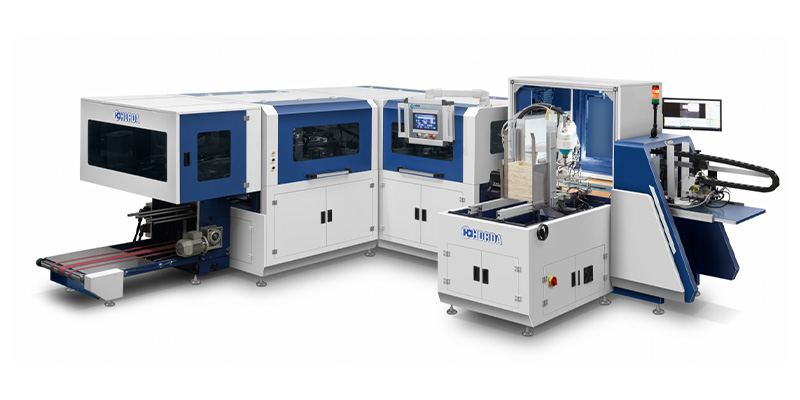
Zhejiang Horda Intelligent Equipment Co., Inc. is a specialist manufacturer of automatic case-making, case-lining and foldable rigid box machinery. Founded in 2007, the company has developed integrated capabilities in research and development, precision component manufacturing, machine assembly, testing and production-line engineering. Its portfolio supports packaging producers working with book-style rigid boxes, magnetic boxes, collapsible boxes, hardcover cases, folders, calendars and other paperboard products that require controlled board positioning and consistent surface finishing.
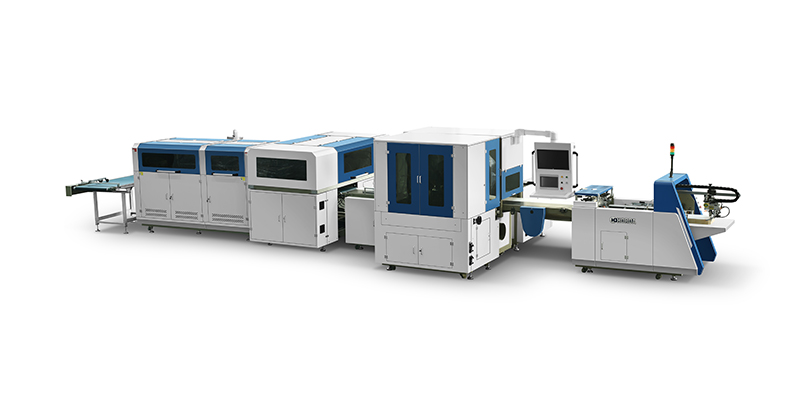
HORDA reports that more than 4,000 of its rigid box production lines have been installed across over 50 countries. The company combines individual machines with supporting equipment and integrated line configurations, enabling projects to be planned around the required product structure, production capacity, material range and degree of automation.
High-Precision Case and Cover Production
High-precision positioning is a central direction within HORDA's current machinery range. Its automatic rigid box case-making machines coordinate cover-paper feeding, adhesive application, board feeding, positioning and four-side folding in a controlled production sequence. Depending on the model and application, positioning can be managed through servo control, photoelectric correction or CCD vision combined with robotic board placement.
Selected CCD-equipped systems specify positioning accuracy within 0.1 mm. This level of control is particularly relevant to premium packaging with narrow borders, registered print, multiple board components or visible alignment requirements. It also supports more consistent spacing between the front board, back board, spine and additional panels, which directly affects opening performance, edge quality and the appearance of the finished case. HORDA's case lining and laminating machines extend this precision to inner-paper positioning, laminating and flattening.
Foldable and Collapsible Rigid Box Production
The company's other principal business direction is foldable and collapsible rigid box machinery. These products require accurate spacing between multiple greyboard panels, stable positioning of covers and side wings, controlled adhesive application and reliable inner lining. They therefore use a different production logic from conventional set-up boxes that remain permanently erected.
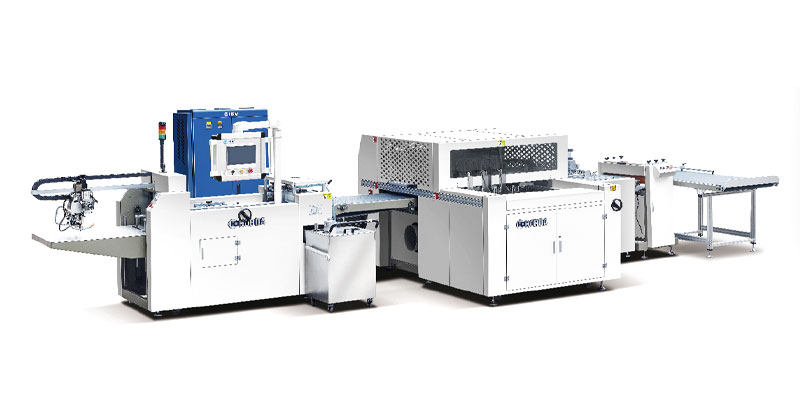
HORDA supplies dedicated machines for foldable covers, collapsible side wings and inner lining, together with an integrated three-in-one configuration that connects cover making, wing making and lining. These systems are developed for flat-pack premium packaging that can be transported and stored in a compact form before final assembly. They are applicable to gift, cosmetics, electronics, wine, tea and other presentation packaging where structural appearance and logistics efficiency must be considered together.
Equipment Range and Production-Line Engineering
Beyond its precision and collapsible-box platforms, HORDA's product range includes high-speed case makers, large-format machines, round-corner case equipment, inner-paper laminating systems and auxiliary equipment for related paperboard processes. Through integrated production-line planning, individual machines can be coordinated with upstream preparation, transfer, lining and finishing requirements. This gives manufacturers a structured path from a standalone equipment investment to a broader automated production system.
Core Technical and Production Capabilities
- High-precision board and lining-paper positioning on selected CCD-equipped models
- Automatic case making for book-style boxes, magnetic covers and hardcover products
- Dedicated cover, wing and lining processes for foldable and collapsible rigid boxes
- High-speed, large-format, round-corner and integrated line configurations
- Machine assessment based on actual structure, dimensions, materials and output targets
Primary production focus: High-precision case and cover manufacturing, multi-board foldable structures, collapsible rigid box components, accurate inner lining and integrated case-making workflows.
2. Emmeci — Italy
Company: Emmeci S.p.A.
Brand: Emmeci
Country: Italy
Website: www.emmeci.it
Emmeci S.p.A. is an Italian engineering company specializing in machinery and automatic production lines for paper-wrapped rigid set-up boxes. Its equipment is widely associated with premium packaging applications in which box geometry, wrapping quality and stable industrial output must be managed within a coordinated process. Research, engineering, machine construction and final testing are organized around the company's manufacturing operations in Tuscany.
The company's rigid box portfolio includes mechanical and electronic automatic lines, digitally controlled platforms for different format ranges, machinery for cylindrical boxes and box-on-demand solutions. This range enables converters to evaluate conventional high-volume production as well as environments characterized by frequent size changes, shorter batches or a broader product mix.
Emmeci also supplies case laminating, cutting, robotic handling and end-of-line technologies. The wider portfolio is relevant when a project extends beyond forming and wrapping a box and requires coordinated material preparation, case production, product handling or downstream automation.
Principal specialization: Automatic production of paper-wrapped rigid set-up boxes, supported by platforms for small, large, cylindrical and on-demand premium packaging.
3. KOLBUS — Germany
Company: KOLBUS Group GmbH
Brand: KOLBUS
Country: Germany
Website: www.kolbus.com
KOLBUS Group GmbH is a German machinery manufacturer with long-established expertise in bookbinding, case making and paperboard converting. Within premium rigid packaging, the company's BOX LINE applies a modular production concept to the manufacture of greyboard structures such as trays, slip-on lids and shoulder boxes.
The system coordinates dedicated punching, forming and wrapping stages rather than treating rigid box production as a single undifferentiated operation. According to KOLBUS specifications, BOX LINE can process greyboard from 1.5 to 4 mm, supports automatic format changes and uses a four-sided laminating method in the wrapping stage without conventional forming tools. These characteristics are directed toward controlled edges, repeatable geometry and industrial format flexibility.
KOLBUS also offers case-making and related packaging technologies, making the company relevant to plants that produce both flat cases and three-dimensional paperboard packaging. The modular architecture allows the production route to be defined according to the box structure and required processing stages.
Principal specialization: Modular production systems for formed greyboard packaging, with coordinated punching, forming and wrapping processes for premium rigid box structures.
4. Europrogetti — Italy
Company: Europrogetti S.r.l.
Brand: Europrogetti
Country: Italy
Website: www.epsrl.it
Europrogetti S.r.l. is an Italian manufacturer focused on automatic machinery for paper-covered rigid cardboard boxes and board-to-paper laminating. Its production systems are designed around the principal stages of rigid box manufacture, including material feeding, gluing, box positioning, wrapping, paper turn-in and pressing, with configurations adapted to different output and format requirements.
The company's equipment range addresses conventional lid-and-base packaging as well as selected special constructions. Flexible format handling and adjustable operating parameters make the systems relevant to converters serving several markets from the same production facility. Applications include cosmetics, perfume, jewelry, eyewear, confectionery, footwear, wine and spirits, and other presentation packaging.
Because individual Europrogetti lines may be arranged for compact, standard or larger-format production, the technical scope should be evaluated at process level. Box style, wrapping sequence, board and paper specifications, pressing requirements and expected changeover pattern determine the appropriate configuration.
Principal specialization: Automatic lines for paper-covered rigid boxes, with flexible format ranges and wrapping configurations for diverse premium packaging applications.
5. Zechini — Italy
Company: ZECHINI GRA.FOR S.r.l.
Brand: Zechini
Country: Italy
Website: www.zechini.com
Founded in Milan in 1952, ZECHINI GRA.FOR S.r.l. designs and manufactures machinery for bookbinding, paper converting and luxury packaging. Its rigid packaging portfolio covers classic set-up boxes, collapsible constructions and boxes assembled with wrapped covers, linking traditional converting knowledge with modular production technology.
The available processes include gluing, corner taping, case making, box wrapping, magnet insertion and component assembly. This breadth allows a converter to select individual production stations or combine complementary machines around a defined box structure. It is particularly relevant where a factory manufactures several types of premium packaging rather than operating a single standardized line.
Zechini also develops box-on-demand configurations for short and medium production runs. Automatic size setting and modular integration are intended to reduce the operational burden of frequent format changes while retaining control over gluing, positioning and wrapping. The final workflow depends on which preparation and finishing operations are brought into the line.
Principal specialization: Modular luxury-packaging equipment for classic, collapsible and cover-wrapped rigid boxes, including configurations for customized and shorter production runs.
6. Perondi — Belgium
Company: Perondi Group bvba
Brand: Perondi
Country: Belgium
Website: www.perondi.eu
Perondi Group is a Belgium-based manufacturer of machinery for case making, board-to-paper laminating, rigid box wrapping, slipcase production, transparent boxes and related paperboard converting. Its portfolio is not limited to one rigid box architecture and can also support the production of displays, game boards, binders, notebooks and other laminated board products.
This cross-application capability is significant for converters whose production mix combines premium packaging with commercial paperboard products. Case-making, laminating and wrapping processes can be evaluated independently or as connected stages, depending on whether the plant starts from prepared components or requires a broader in-house converting workflow.
Perondi also maintains technical continuity with the installed base of Perondi and Crathern machinery. Alongside new equipment, its activities include spare parts, upgrades, rebuilding and revised used machines. This lifecycle capability provides an additional route for plants that need to extend, modernize or maintain existing assets.
Principal specialization: Case making, laminating and rigid box wrapping, combined with equipment lifecycle services for new and installed Perondi or Crathern machinery.
7. Fuchu Shiko — Japan
Company: Fuchu Shiko Co., Ltd.
Brand: FUCHU SHIKO
Country: Japan
Website: www.fuchu-shiko.jp
Fuchu Shiko Co., Ltd. was established in Hiroshima in 1960 and operates in both rigid paper box production and machinery manufacturing. This dual role gives the company direct exposure to the practical relationship between machine design, paper and board behavior, operator procedures and finished-box quality.
Its machinery activities include automatic and semi-automatic equipment for paper containers and conventional wrapped rigid boxes. Rather than approaching equipment solely as a mechanical product, Fuchu Shiko's manufacturing profile reflects experience with the production environment in which the machines are used, including preparation, forming, wrapping and finishing considerations.
For buyers outside Japan, the technical review should include the available machine configuration, application testing, export specification, operator documentation, installation arrangements and after-sales coverage for the destination market. These project elements are separate from the underlying equipment capability and should be confirmed during procurement.
Principal specialization: Japanese rigid box and paper-container machinery supported by long-term operating experience in both packaging production and equipment manufacture.
8. SATE — Italy
Company: SATE S.r.l.
Brand: SATE
Country: Italy
Website: www.sate.eu
Founded in 1956, SATE S.r.l. is an Italian engineering company dedicated to automation for luxury packaging. Its machinery portfolio is centered on rigid box production, case making, board processing and robotic handling, with equipment designed and manufactured in Pistoia, Tuscany.
The S-Line includes the S700 and S500 modular rigid box production systems. Independent units can be synchronized as a connected line, giving packaging manufacturers the option to establish a defined production cell and expand the level of automation as output or process requirements develop. This architecture is intended to balance industrial continuity with the ability to configure the line around a specific product range.
SATE's wider portfolio includes SA Series laminators and case makers, SC Series corner cutters, robotic co-packing cells and ST Series robotic box-capping systems. The combination of core box-making equipment and downstream robotics makes the company particularly relevant to luxury packaging plants evaluating a coordinated production ecosystem rather than an isolated machine.
Principal specialization: Modular automatic rigid box lines, high-precision case-making equipment and robotic systems for luxury packaging production.
9. CMC Italia — Italy
Company: CMC Italia S.r.l.
Brand: CMC Italia
Country: Italy
Website: www.cmc-italia.com
CMC Italia has manufactured machinery for paper converting and bookbinding since 1937. Its equipment is used for hardcover cases, binders, sample books, paper-over-board products and rigid box components, placing the company within the production area shared by premium box making and traditional case making.
The CMC Italia range includes Q-COVER case makers for short and medium runs, H-LINE laminating and case-making systems, Helios and Heliomat gluing equipment, Virgo turn-in machines and Castor board-grooving machines. These technologies cover several preparation and finishing stages involved in converting greyboard and covering material into accurately wrapped flat structures.
For three-dimensional rigid boxes, the Q-TAPE forming machine applies heat-activated tape to prepared corners before the box enters the wrapping process. This modular approach allows manufacturers to combine board preparation, gluing, spotting, turn-in and box-forming equipment according to the required product structure and production volume.
Principal specialization: Modular case making, paper-over-board laminating, board grooving and rigid box forming equipment for short- and medium-run production.
10. HÖRAUF — Germany
Company: Michael Hörauf Maschinenfabrik GmbH & Co. KG
Brand: HÖRAUF
Country: Germany
Website: www.hoerauf.com
HÖRAUF is a German machinery manufacturer recognized for industrial case-making technology. Its BDM Series is designed for the automatic production of covered board cases, a process used in hardcover books as well as premium packaging components, multi-piece covers and other paper-over-board products.
The portfolio includes the BDM DIGITAL Evolution, BDM UNIVERSAL, BDM SPEED, BDM SUPERIOR and BDM 20. Individual models address different combinations of format flexibility, difficult covering materials, short setup requirements and industrial output. Depending on the selected system, the range reaches production rates of up to 85 cases per minute.
For rigid box manufacturers, HÖRAUF is most relevant to the flat-case and cover stage rather than the complete forming and wrapping of a conventional set-up box. Its equipment can therefore form part of a wider line for book-style, magnetic or hinged packaging where accurate board placement and consistent edge turn-in are fundamental to the finished structure.
Principal specialization: High-output industrial case makers for covered board products, with emphasis on format flexibility, rapid changeover and consistent case quality.
How to Compare Rigid Box Machine Manufacturers
A manufacturer overview establishes the available field, but investment decisions require a process-level comparison. The term rigid box machine may refer to a complete set-up box line, a flat-case maker, a positioner, a wrapper, a former or one stage of a collapsible box workflow. Suppliers should therefore be evaluated against the same technical specification after the required inputs, automated operations and finished outputs have been defined. For additional terminology, see Rigid Box Machine Types and Terms Explained.
Finished Box Structure
Define whether the product is a lid-and-base, shoulder, drawer, book-style, magnetic, round or collapsible box. Products with similar external dimensions may require fundamentally different board preparation, forming, wrapping and assembly processes.
Exact Process Boundary
Confirm whether board cutting, grooving, corner pasting, gluing, positioning, wrapping, four-side folding, lining, pressing and final assembly are included in the proposed line or remain separate operations. The commercial quotation and layout should show these boundaries clearly.
Real Material Trials
Conduct trials with the actual greyboard, printed paper, specialty paper, coated stock, cloth or other covering material. Testing should include representative products at the minimum and maximum format limits, not only a standard demonstration sample.
Positioning and Quality
Match mechanical, photoelectric or CCD positioning to the artwork, border width, component count and permissible tolerance. Acceptance criteria should define measurable requirements for alignment, panel spacing, corner finish, folding consistency and visible surface quality.
Accepted Output and Changeover
Compare saleable output per shift rather than relying exclusively on maximum cycle speed. A realistic calculation should include material replenishment, format changes, tooling, inspection, operator tasks, material behavior and normal production interruptions.
Project and Service Scope
Review the proposed layout, utilities, machine connections, molds and tooling, installation, commissioning, training, technical documentation, spare-parts package and regional service arrangement. These items materially affect total project cost, startup time and long-term operating continuity.
Recommended procurement method: Provide every shortlisted manufacturer with the same box drawings, finished dimensions, material specifications, quality tolerances, target output and current process flow. Request a documented response covering machine scope, exclusions, test results, utilities, delivery, installation and acceptance. Consistent input data makes technical and commercial proposals substantially easier to compare.
Frequently Asked Questions
Are all ten manufacturers direct alternatives?
No. Some manufacturers concentrate on complete automatic set-up box lines, while others specialize in case making, wrapping, modular converting, collapsible structures or supporting processes. A valid comparison requires matching the exact machine function, box construction and process boundary rather than the broad equipment category.
Does a fully automatic rigid box machine include the complete workflow?
Not necessarily. “Fully automatic” normally applies to the processes performed within a specified machine or line. Greyboard preparation, corner pasting, lining, component assembly, inspection or transfer between machines may still remain separate.
Is a case maker the same as a rigid box former?
No. A case maker normally positions flat board components on glued covering material and folds the edges to create a flat case. A rigid box former or wrapper generally processes a three-dimensional box shell or prepared blank. Book-style, magnetic and certain collapsible structures may require case-making operations in addition to forming, lining or assembly.
When is CCD visual positioning appropriate?
CCD visual positioning is especially relevant when the product uses registered print, narrow borders, several board components or alignment features that must remain consistent from one case to the next. The required system should still be confirmed through trials with the buyer's actual artwork, materials and tolerance criteria.
What distinguishes a collapsible rigid box production system?
A collapsible rigid box generally uses several accurately spaced board panels, flexible joints, side wings and an inner lining so that the structure can remain flat during storage and transport before assembly. Its production system must control the relationship between these components; this differs from a conventional set-up box line that forms a permanently erected shell.
What should a buyer provide before requesting a quotation?
Provide the box structure, technical drawings or physical samples, minimum and maximum dimensions, greyboard thickness, covering and lining materials, required processes, target output, quality tolerances, factory voltage, available floor space and destination country. Information about current production methods and anticipated order sizes also improves line planning.
Final Thoughts
The international rigid box machinery market is defined by several production philosophies rather than one universal machine architecture. Emmeci, Europrogetti and SATE concentrate on automatic or modular set-up box systems; KOLBUS applies a coordinated greyboard converting concept; Zechini, Perondi and CMC Italia span multiple case-making, laminating and finishing processes; Fuchu Shiko combines packaging production with machinery experience; and HÖRAUF contributes established industrial case-making technology.
HORDA's principal direction combines high-precision automatic case production with dedicated machinery for foldable and collapsible rigid box components. These capabilities address two important requirements in premium packaging: consistent visual alignment and the ability to manufacture complex flat-pack structures with controlled spacing, folding and lining.
Regardless of manufacturer, a sound equipment decision should be based on the buyer's actual product range, materials, process boundaries and production objectives. Sample validation, measurable acceptance standards and a written definition of every included operation provide a more reliable basis for investment than nominal speed or a general product label alone.
Planning a High-Precision or Foldable Rigid Box Project?
Provide the box drawing, finished dimensions, board and covering materials, required accuracy, target output and existing production process. HORDA's engineering team can evaluate whether the application requires a high-precision case maker, case-lining machine, foldable or collapsible rigid box system, supporting equipment or an integrated production line.