
How Does an Automatic Rigid Box Making Machine Work?
An automatic rigid box making machine feeds cover paper, applies glue, positions greyboard and folds the paper around the board edges. In a case-making configuration, the output is a wrapped outer case. An integrated line can also apply an inner lining, while final box assembly may require separate equipment.
The Working Process at a Glance
Paper feeding → Gluing → Greyboard positioning → Four-side folding → Case discharge or inner lining
What Does a Rigid Box Making Machine Do?
It automates the production of rigid packaging components from greyboard and covering paper. The exact output depends on the machine: some produce wrapped cases, while other systems form and wrap three-dimensional box trays.
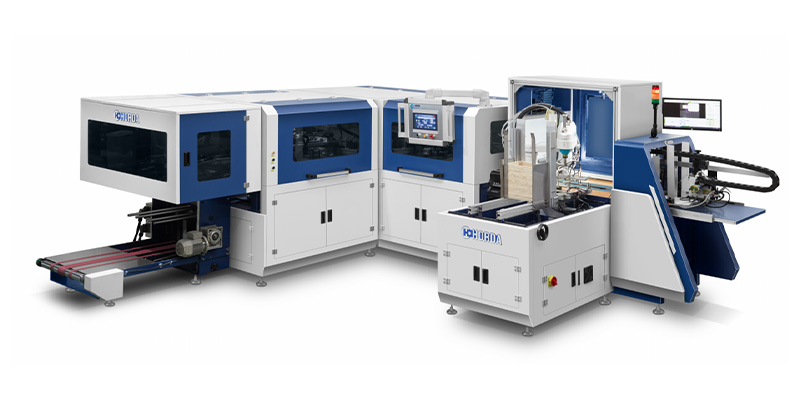
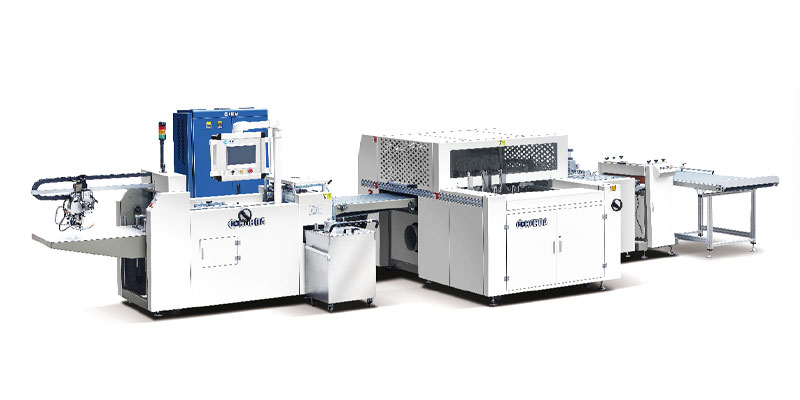
For HORDA’s rigid box making machines, the main case-making operations are paper feeding, gluing, board positioning and four-side folding. These wrapped cases can become the outer covers of book-style boxes, magnetic boxes and similar packaging.
How Does the Automatic Process Work?
The machine moves prepared paper and board through a coordinated series of feeding, bonding and folding stations. Board cutting and cover printing normally take place beforehand.
- Feed the materials. The feeder separates cover sheets from the stack, while the board-feeding section supplies the greyboard pieces required for the case layout.
- Apply the adhesive. The gluing unit coats the bonding side of the cover paper. The adhesive layer must hold the board securely without excessive squeeze-out.
- Position the greyboard. The positioning system places the boards onto the glued sheet, controlling alignment, paper margins and the gaps between panels.
- Fold and press the edges. The folding section turns the projecting paper margins around the board edges and presses them onto the reverse side.
- Discharge or continue to lining. The wrapped case leaves the machine or transfers to a connected section that applies the interior lining sheet.
During continuous production, several workpieces can pass through different stations at the same time. The control system synchronizes their movement to maintain a steady cycle.
How Is Greyboard Positioned Accurately?
The machine uses material references and controlled movement to place each board at its specified location. Depending on the model, positioning may involve photoelectric detection or CCD vision guidance.
In a multi-panel case, positioning controls more than the outside edges. It also establishes the gaps between boards, which allow the cover to bend and close.
- Board alignment: Keeps the panels square to the cover layout.
- Panel spacing: Creates the flexible joints between board pieces.
- Paper margins: Leaves sufficient covering material for edge folding.
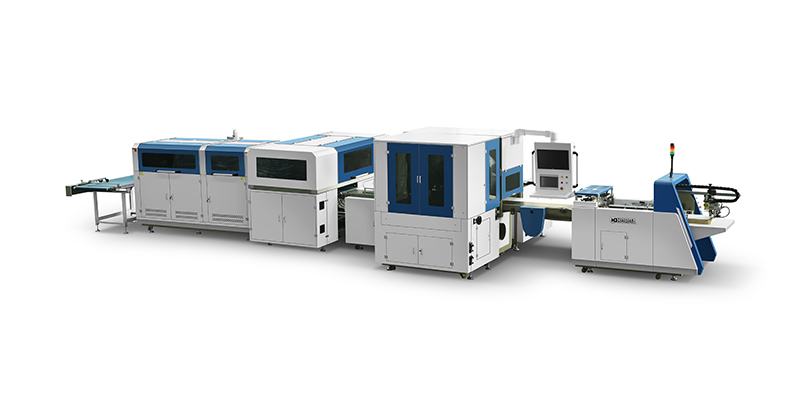
HORDA’s QZFM-700B uses CCD vision-guided positioning. Accurate board cutting and stable paper feeding remain necessary because vision guidance cannot correct every material defect.
How Does Four-Side Folding Work?
Four-side folding wraps the excess cover paper around the greyboard’s perimeter and presses it onto the back. This covers the exposed board edges and finishes the outside of the case.
The machine holds and guides the workpiece as folding elements turn in the margins. Folding order and corner handling vary with the equipment design.
What Makes a Clean Fold?
- Even margins: Enough paper for secure bonding along every edge.
- Correct corner preparation: Prevents exposed board or bulky overlaps.
- Suitable pressure: Bonds the folded paper without marking the surface.
What Is the Difference Between Case Making and Inner Lining?
Case making finishes the exterior; inner lining covers the inside surface. They are separate operations that can run independently or within one connected line.
- Case making: Bonds cover paper to greyboard and folds the outer edges.
- Inner lining: Applies an interior sheet over the exposed board and turned-in margins.
- Final assembly: Joins the case to a tray or adds other packaging components.
A standalone case maker discharges wrapped cases for later processing. A separate case lining and laminating machine handles the interior sheet, while an integrated line transfers cases directly between these stages.
Here, “inner lining” means a bonded interior sheet. It does not mean installing foam inserts or fitted product trays.
Do All Rigid Box Machines Use the Same Process?
No. The process depends on whether the machine makes a flat case, forms a box tray or combines several finishing operations.
Even among case makers, configurations differ in:
- Photoelectric or CCD vision-guided positioning.
- Supported case sizes, board thicknesses and panel layouts.
- Folding mechanisms and corner-finishing capabilities.
- Standalone discharge or automatic transfer to inner lining.
For example, HORDA’s ZFM-700K is a case maker, while the QZFM-700B combines case making and lining with CCD positioning. Their outputs should be compared by the operations completed, as well as speed.
How Fast Can the Machine Run?
Speed varies by model and job specification. HORDA lists the ZFM-700K at up to 35 cases per minute and the QZFM-700B integrated line at 20–30 pieces per minute. These figures apply to different configurations.
Actual output depends on case size, panel layout, paper condition, adhesive performance and folding difficulty. Material replenishment, adjustments and stoppages also affect total shift output.
Check what the speed measures: wrapped cases, lined cases and fully assembled boxes represent different production stages.
What Does the Operator Still Need to Do?
The operator prepares the job, loads materials, checks the first samples and monitors production. Automatic operation reduces repetitive handling, but setup and quality checks remain essential.
- Set the case dimensions, board layout and folding parameters.
- Load prepared cover sheets and correctly sized greyboard.
- Adjust adhesive application for the covering material.
- Check alignment, joint gaps, corners and bonding before the full run.
- Replenish materials and clean adhesive-contact parts as required.
Does the Machine Make a Complete Finished Box?
A case maker produces the wrapped outer case; a case-making and lining line produces a lined case. Neither output automatically includes every component of a finished package.
A book-style box may still need a separately prepared tray, magnetic closure or product insert. Those operations are included only when the production system specifically provides for them.
To understand any machine’s scope, check its input materials and discharged product: a flat wrapped case, a lined cover or a formed box tray.