
How Does Four-Side Folding Work on a Rigid Box Making Machine?
Four-side folding turns the cover paper margins around the greyboard edges and presses them onto the reverse side. The result depends on paper size, board placement, adhesive coverage and folding settings.
In case-making equipment, this operation finishes the perimeter of a flat rigid case. Inner lining, tray attachment and complete box assembly are separate stages unless the production system specifically includes them.
What Is Four-Side Folding in Rigid Box Production?
Four-side folding wraps the projecting cover paper around the four outer edges of a greyboard case and bonds the margins to its inside surface. It covers the exposed board edges and creates a finished perimeter.
The paper extending beyond the board is often called the turn-in allowance. It must cover the board thickness and leave enough material on the reverse side for a secure bond.
For a multi-panel cover, four-side folding finishes the outside perimeter of the complete case layout. It does not mean folding every individual board edge or erecting a three-dimensional box tray.
What Comes Out of This Stage?
A wrapped case with covered outer edges. Its inside may still show exposed greyboard and folded paper margins until a separate lining operation is completed.
How Does an Automatic Edge-Folding System Work?
The system supports the case while folding elements turn the paper margins around the board edges, then press them into contact with the adhesive-coated surface. The folding order and corner-handling method depend on the machine.
- Locate and support the case. The positioned paper-and-board assembly enters the folding section and is held or guided against unwanted movement.
- Turn the paper around the edges. Folding elements guide the projecting margins over the board thickness and onto the reverse side.
- Control the corners. Prepared corner cuts and the machine’s corner-handling action allow adjacent margins to meet with suitable coverage and overlap.
- Press and discharge. The folded margins are pressed down before the case leaves the station or continues to another process.
“Four-side” describes the edges completed, not necessarily four simultaneous movements. Machines may fold opposing sides in sequence or use another coordinated arrangement.
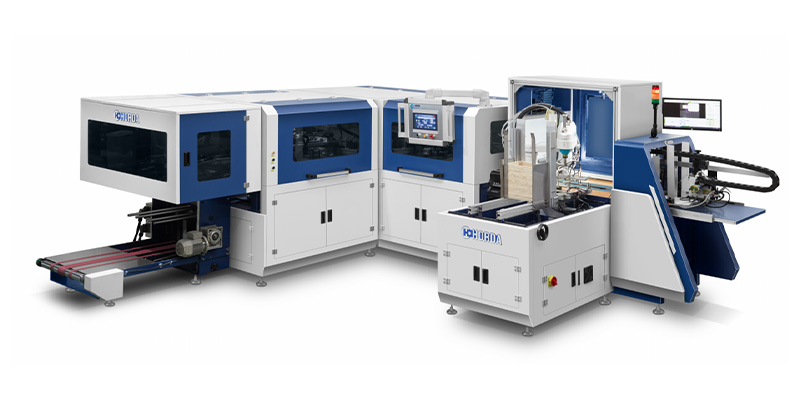
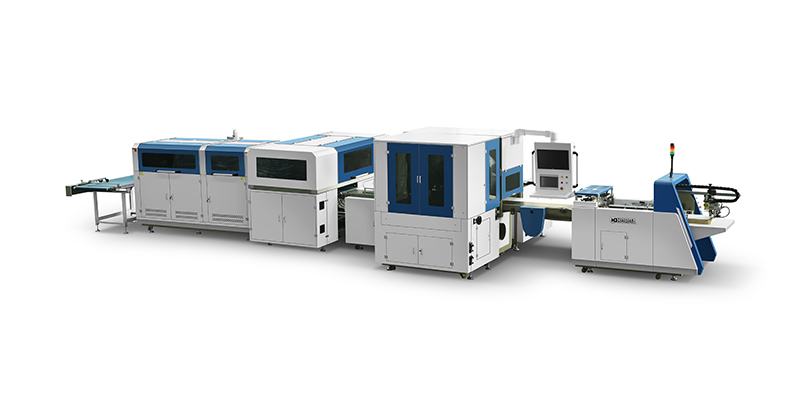
HORDA describes the ZFM-700K as using platform-based folding that completes the four sides on a single plane. Across its rigid box making machine range, folding capability should be checked against the actual case dimensions, panel layout and edge requirements.
What Happens Before the Folding Stage?
The cover paper must be prepared, glued and combined with accurately positioned greyboard before the edges can be folded consistently. Folding cannot fully compensate for unsuitable materials or an incorrect starting layout.
- Paper preparation: Cut the cover to the specified size and prepare any required corner cuts.
- Board preparation: Check panel dimensions, squareness, thickness and edge condition.
- Adhesive application: Provide suitable coverage on the areas that must bond, including the turn-in margins.
- Board positioning: Establish the paper margins and gaps between panels.
- Transfer timing: Deliver the assembly while the adhesive remains workable for folding and pressing.
Before increasing production speed, inspect a sample after board placement. Unequal margins at this point are an upstream problem that should be corrected before adjusting the folding section.
How Should Cover Paper Size Match the Board Layout?
Cover paper must accommodate the complete board layout, including panel gaps, board thickness and the required turn-in on each outer edge. Finished box dimensions alone are not enough to determine the sheet size.
Start with the flat case drawing. Check the outside dimensions of the positioned boards, then establish the wrapping allowance for each edge according to the material and machine requirements.
Margin Too Narrow
May leave insufficient bonding area or expose greyboard, especially near corners.
Margin Too Wide
May create excessive overlap, interfere with the folding mechanism or extend into areas intended for lining or joints.
Corner Cut Incorrect
May remove too much material and expose the corner, or leave too much material and create a bulky overlap.
There is no single allowance suitable for every case. Confirm it using the actual board thickness, cover material, corner design and folding configuration.
How Does Board Thickness Affect Edge Folding?
Thicker board changes the distance the paper must wrap around the edge and the clearances needed in the folding section. It can also change how the corner overlap forms.
When changing board thickness, review the cover-paper allowance, corner preparation and folding adjustments together. A setup approved for thinner board may leave insufficient coverage or unsuitable pressure on a thicker job.
- Wrapping allowance: Must cover the board edge and leave the specified reverse-side turn-in.
- Machine clearance: Must accommodate the board and covering material without dragging or crushing.
- Corner settings: Must suit the thickness and the amount of material meeting at the corner.
- Material flexibility: Must allow the cover to bend without unacceptable cracking or lifting.
More pressure is not automatically better. Excessive pressure can mark the surface or compress the board, while unsuitable material or inadequate adhesive coverage may remain unresolved.
Why Is Accurate Board Positioning Important for Folding?
Board positioning determines how much paper remains available on each edge before folding begins. An offset or skewed board layout can produce unequal turn-ins even when the folding mechanism operates consistently.
On a multi-panel case, positioning also establishes the joints between the front, back, spine and any additional panels. Those gaps must remain suitable for the cover to open and close.
Check both the board-to-paper relationship and the spacing between boards. A case can have an apparently neat outer edge while still containing an incorrectly positioned spine or joint.
Practical check: If one turn-in is consistently narrow and the opposite one is wide, inspect paper size and board placement before changing folding travel.
What Causes Common Edge-Folding Defects?
Common defects can result from mismatched paper allowances, positioning errors, adhesive conditions, material behavior or folding adjustments. Identify where the defect first appears before changing settings.
Lifted or Loose Edges
Check adhesive coverage, working time, pressing contact and turn-in width. Also inspect whether a stiff or curled covering material is pulling away after discharge.
Exposed Greyboard at Corners
Check the corner cut, board position and available paper. A corner cut too close to the board can remove material needed for coverage.
Bulky or Wrinkled Corners
Check for excessive overlap, unsuitable corner preparation and incorrect folding sequence or adjustment. Confirm that the cover material suits the corner design.
Scratches, Cracking or Pressure Marks
Inspect contact surfaces, clearances and pressure settings, together with the paper, coating or lamination. Surface damage should not automatically be attributed to the adhesive.
How Do You Inspect the Finished Edges?
Inspect coverage, turn-in consistency, corner finish, bonding and surface condition across a representative production sample. Check the cases after the agreed adhesive setting period as well as immediately after folding.
- Edge coverage: No unintended exposed board along the perimeter.
- Turn-in width: Consistent with the drawing and suitable for subsequent lining.
- Corner finish: Adequate coverage without excessive bulk, wrinkles or loose overlaps.
- Bonding: Folded margins remain attached under the agreed inspection method.
- Surface condition: No unacceptable scratches, cracks, glue contamination or pressure marks.
- Case function: Panels and joints open and close as intended without pulling the covering material loose.
Retain an approved sample and define acceptable variation before the run. Recheck after changes in size, board thickness, covering material or operating speed, since different jobs can require different folding settings.