
What Machines Make Rigid Boxes?
Making a rigid box usually requires several machines, not one universal rigid box machine. A typical process may use equipment for greyboard cutting, grooving, corner pasting or box forming, paper gluing, positioning, wrapping, edge folding, case making, lining, assembly and finishing. The exact combination depends on the box structure and on which materials arrive at the factory already prepared.
This is why the term rigid box production line needs context. It may describe a connected group of machines for one section of production, such as tray wrapping or hardcover case making. It does not automatically mean that one machine converts raw greyboard and printed paper into a packed, finished box.
A practical way to understand the equipment is to divide production into four stages:
- Material preparation: cut and groove the greyboard and prepare the covering paper.
- Box blank or shell production: erect, join and square the lid, base, tray or other structural part.
- Covering: glue, position, wrap and fold the decorative paper around the board or formed shell.
- Assembly and finishing: combine the components, add lining or closures, press and inspect the box.
Machines for Greyboard Cutting
Rigid boxes normally begin with dense greyboard, also called grayboard or rigid paperboard. Large sheets must be converted into accurately sized blanks or separate panels before forming or covering can begin. Small dimensional errors at this stage can later appear as uneven gaps, mismatched lids, twisted trays or misaligned covering paper.
Board slitting and cutting machines make straight, repeatable cuts and are commonly used for rectangular lid, base, sidewall, spine and cover panels. A guillotine-style board cutter may be used for general sheet sizing, while a slitting machine is useful for repeated strips or panels.
Die-cutting equipment is more suitable when a blank needs tabs, windows, curved edges, lock structures or an irregular outline. An angle or corner cutter may also remove selected areas so that thick board can fold or wrap without excess material building up at the corners.
The output of this stage is still only prepared board. A greyboard cutter does not form the box, apply decorative paper or complete the rigid box. Printed covering paper is also usually printed, laminated and cut in a separate upstream process before it enters the box-making section.
What Does a Grooving Machine Do?
A grooving machine creates controlled fold lines in thick greyboard. It removes a narrow V-shaped channel from the board while leaving a thin supporting layer intact. This allows the material to fold into a sharp edge with less bulging than a simple score line would produce.
Grooving is often used for one-piece rigid box blanks, outer sleeves, book-style structures and collapsible panels. Groove position, angle and depth must match the board thickness and the intended fold. A groove that is too shallow can produce a rounded or resistant fold; one that is too deep can weaken the hinge or expose the covering material.
Grooving prepares a fold; it does not create a finished box shell. Some structures use separate board panels, die-cut folds or controlled gaps between panels instead, so not every rigid box requires the same grooving process.
Corner Pasting and Box Forming Machines
Once the board blank has been cut and, where required, grooved, it must be converted into a stable three-dimensional shell. This is the box blank stage for a traditional lid, base or inner tray.
A corner pasting machine, also called a corner taping machine, holds adjacent walls together after the blank is erected. Depending on the process, it may apply heat-activated tape, paper tape or adhesive at the corners. Its output is a square, unwrapped box shell that can move to gluing and wrapping.
A rigid box forming machine may use a mould to fold the blank, erect the sidewalls, square the shell and press the joints. Some models combine forming with corner pasting, while others receive a shell whose corners have already been fixed. Because machine names vary between manufacturers, the important questions are what material enters the machine and which process is complete when it exits.
Typical input: a cut or grooved greyboard blank.
Typical output: an erected but not yet decoratively wrapped lid, base or tray.
This equipment should not be confused with a corrugated case erector. Rigid setup boxes use dense board and a covering process, so their forming and finishing requirements are different from those of shipping cartons.
Wrapping and Folding Machines
After a traditional rigid box shell has been formed, decorative paper must be attached to its outer surfaces. This section may be handled by separate machines or by an integrated automatic system.
A paper gluing machine applies an even adhesive layer to the reverse side of the covering paper. A positioning unit then places the formed shell on the glued sheet according to the required margins and print orientation. Camera or photoelectric positioning may be used when close alignment is required.
A box wrapping and folding machine turns the paper around the outer walls, folds the remaining paper over the rim and presses the material into the inner edges. Depending on the machine, side wrapping, edge folding, corner tucking and pressing may be completed in one cycle. The aim is consistent registration, tight corners and smooth covered surfaces.
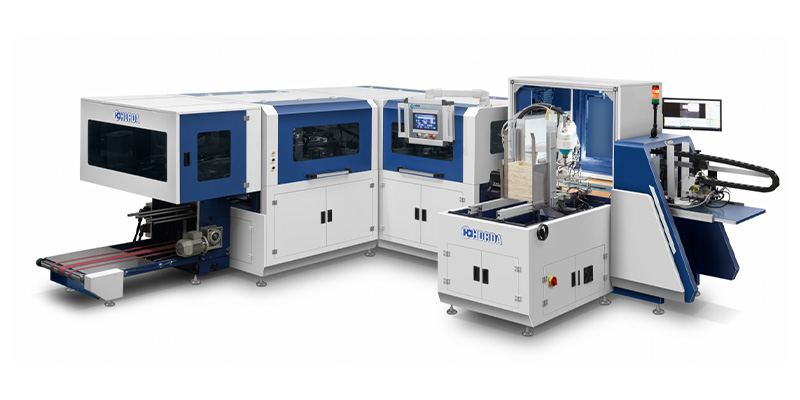
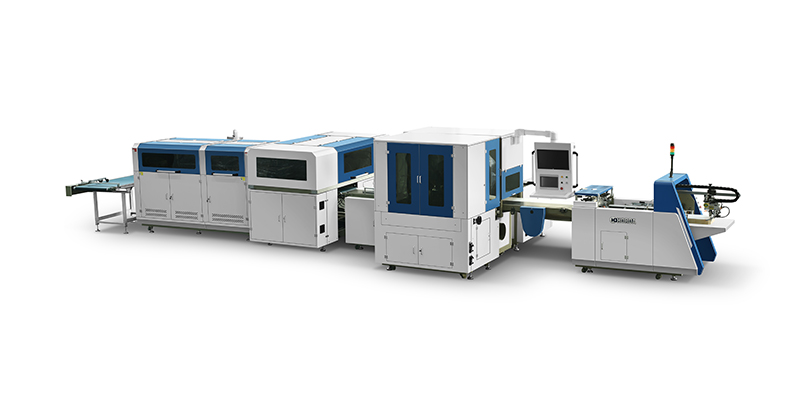
An automatic rigid box making machine may integrate paper feeding, gluing, positioning, wrapping and folding. Even then, it may still require a preformed shell as its input and may not include greyboard cutting, grooving, corner pasting, lining or final assembly. The machine boundary must therefore be checked process by process.
Case Making and Case Lining Machines
A case making machine serves a different purpose from a three-dimensional box wrapping machine. It makes a flat rigid case for book-style boxes, hardcover books, folders and similar products.
In a typical case-making cycle, the machine feeds and glues the surface paper, positions separate greyboard panels and a spine piece, and folds the paper over all four edges. The controlled spaces between the boards create the hinges that allow the case to open and close. The resulting component is a covered flat case, not the inner tray of the box.
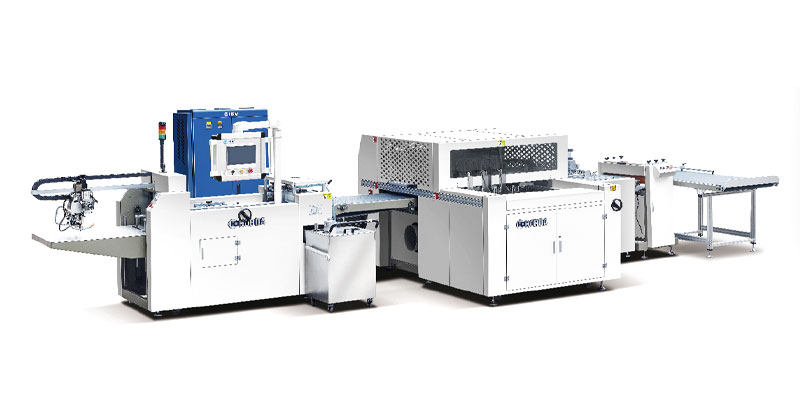
A case lining machine laminates inner paper onto the exposed side of the case. This covers the board, improves the interior finish and can help stabilize the completed case. Some systems combine case making and lining, while other factories perform them on separate machines. HORDA's rigid box making machine category includes automatic case-making equipment for book-style rigid packaging and other hardcover products.
For a book-style rigid box, the case and the inner box are two different components. The inner tray still needs its own board preparation, forming and covering processes before it can be mounted inside the finished case.
Assembly and Finishing Equipment
Assembly begins after the main structural and covered components are ready. The required equipment depends on how those components connect and which decorative or functional details the box includes.
- Gluing and positioning equipment can mount an inner tray onto a book-style case or attach additional board and paper components.
- Pressing and flattening machines improve contact between laminated layers and help reduce bubbles, loose areas or uneven surfaces.
- Hole-punching and cutting equipment prepares openings for ribbons, handles, closures or other structural details.
- Closure and accessory stations may install magnets, ribbons, windows, hinges, partitions, foam or moulded inserts.
- Inspection equipment or manual quality checks verify alignment, corner shape, adhesive bonding, opening action and surface condition.
Many of these are auxiliary or finishing machines. They can be essential to a specific design, but a hole-punching machine, angle cutter, glue applicator or flattening machine should not be presented as a complete rigid box machine on its own.
Machines Needed for Different Box Types
There is no single equipment list that fits every rigid box. Start with the box construction, then separate the production of each component.
Traditional lid-and-base rigid box
Both the lid and base are three-dimensional shells. A common process is greyboard cutting, optional grooving or die-cutting, corner pasting or forming, covering-paper gluing and positioning, box wrapping and folding, followed by pressing and inspection. The two components are produced to matching dimensions but normally pass through the same types of operations separately.
Book-style rigid box
This construction has two production paths. A case making and lining process creates the hinged outer cover. A separate forming and wrapping process creates the inner tray. Gluing, positioning and pressing equipment then mounts the tray onto the case. A case maker alone therefore does not complete the entire book-style box.
Drawer rigid box
A drawer box combines an inner tray with an outer sleeve. The tray may require cutting, forming, corner pasting and wrapping. The sleeve may be produced from grooved and wrapped board or from separately positioned board panels, depending on its design. Final sizing must allow the drawer to slide smoothly without excessive movement.
Collapsible rigid box
A collapsible design is manufactured to fold flat for storage and transport, then open into a rigid form. Production may include board cutting and grooving, covering-paper gluing and positioning, cover or wing making, hinge and closure preparation, panel assembly and final folding checks. Dedicated collapsible box making machines can combine key cover-and-wing processes, but upstream material preparation and later accessory or insert fitting may remain separate.
Does Every Factory Need a Complete Line?
No. A factory only needs the equipment required for the production stages it performs in-house. One factory may receive pre-cut board and printed paper, another may make the case internally but source the inner tray, and a third may connect several automatic machines from board preparation through assembly.
The phrase complete rigid box production line is meaningful only when its starting material and finished output are defined. It could refer to a complete tray forming and wrapping line, a complete case making and lining line, or an end-to-end line configured for one particular box structure.
To define the necessary equipment clearly, map the process around these questions:
- Which box type and component structures will be produced?
- Will the factory receive large greyboard sheets, pre-cut blanks or preformed shells?
- Will the covering paper arrive printed, finished, cut and ready for gluing?
- Which stages are manual, semi-automatic, standalone automatic or physically linked?
- Do board thickness, box dimensions, adhesives and paper types fit every connected machine?
- Are lining, closures, inserts and final assembly included in the defined line boundary?
Machines also need compatible outputs and inputs. A fast wrapper cannot remove a bottleneck if formed shells arrive too slowly, and accurate case making cannot correct panels that were cut to inconsistent dimensions. Process compatibility matters more than whether every machine carries the same broad label.
The Machine List Starts With the Box Structure
The machines used to make rigid boxes can cover material preparation, box-shell production, decorative wrapping, flat-case production, lining, assembly and finishing. A traditional lid-and-base box, a book-style box, a drawer box and a collapsible box do not follow exactly the same route.
Before calling any setup a rigid box production line, identify the input, output and completed operation at every stage. This prevents a board cutter, corner paster, case maker or other auxiliary unit from being mistaken for a machine that performs the whole production process.