
Automatic vs Semi-Automatic Rigid Box Machines
A fully automatic rigid box machine controls more feeding, gluing, positioning, forming, wrapping, folding and transfer steps in a continuous cycle. A semi-automatic machine automates selected movements but still relies on operators to load, align, transfer or finish components. The practical difference is the production workflow, not simply machine speed.
Fully automatic production is generally more effective for stable materials, repeat products and continuous orders. Semi-automatic production remains useful for short runs, frequent structural changes, specialty materials and boxes that require substantial manual assembly.
The automation label must always be linked to a defined process. A fully automatic case-making machine may automatically produce a flat wrapped case, but it does not necessarily print the cover paper, cut the greyboard, form the inner tray or assemble a finished book-style box.
Automatic vs Semi-Automatic Rigid Box Machines: Quick Comparison
| Comparison Point | Semi-Automatic Rigid Box Machine | Fully Automatic Rigid Box Machine |
|---|---|---|
| Process scope | Automates one or several selected operations. | Connects more operations into a continuous machine cycle. |
| Operator role | Operators commonly load, position, transfer or remove each component. | Operators mainly prepare materials, set parameters, monitor production and handle exceptions. |
| Production flow | Separate workstations with manual transfer and intermediate storage. | More continuous feeding, processing, transfer and delivery. |
| Effective output | More affected by operator rhythm and manual handoffs. | Usually higher on stable, sufficiently long production runs. |
| Quality control | More dependent on operator technique, observation and correction. | More repeatable in the automated movements, but still dependent on materials and setup. |
| Changeover | Often easier to reorganize for unusual structures and small orders. | Can be fast for stored repeat formats, but several connected stations may require adjustment. |
| Material consistency | Operators can compensate for a wider range of material behavior. | Requires more consistent paper, board, shells, adhesive and accessories. |
| Production pattern | Common in mixed orders, special boxes, prototypes and short runs. | Common in repeat orders and standardized continuous production. |
| Investment and layout | Usually lower for an individual station and easier to arrange as separate production cells. | Usually higher because more feeding, control, transfer, safety and utility systems are included. |
Important: There is no universal speed or price range that applies to every automatic or semi-automatic rigid box machine. A single-process wrapping machine, an automatic case maker and an integrated production line have different inputs, outputs and production capacities.
What Is a Semi-Automatic Rigid Box Machine?
A semi-automatic rigid box machine mechanizes one or more repetitive, physically demanding or accuracy-sensitive operations while leaving selected material handling to an operator.
Depending on the machine, the operator may still need to:
- Place cover paper, greyboard or a pre-formed shell into position
- Start each production cycle
- Wrap, turn or remove the processed component
- Transfer work between gluing, positioning, wrapping and pressing stations
- Inspect and correct individual products during production
For example, a gluing machine may apply an even adhesive layer while an operator positions and wraps the box manually. Another semi-automatic machine may control shell forming or pressing but still require manual loading and unloading.
Semi-automatic does not mean low quality. It describes how work is divided between the machine and the operator. This arrangement can be practical when products change frequently or require individual handling.
What Is a Fully Automatic Rigid Box Machine?
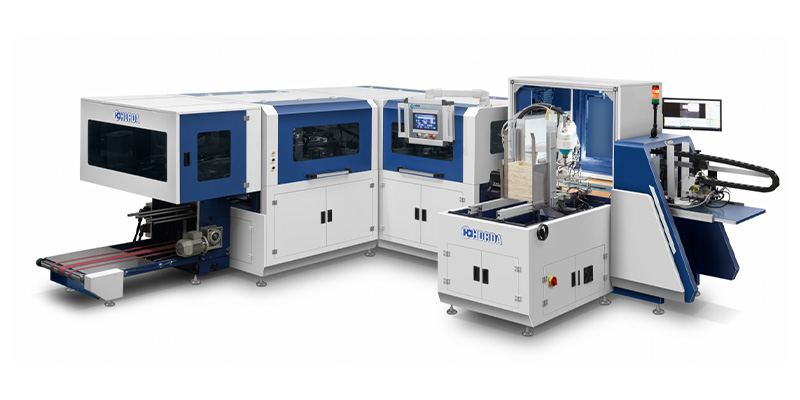
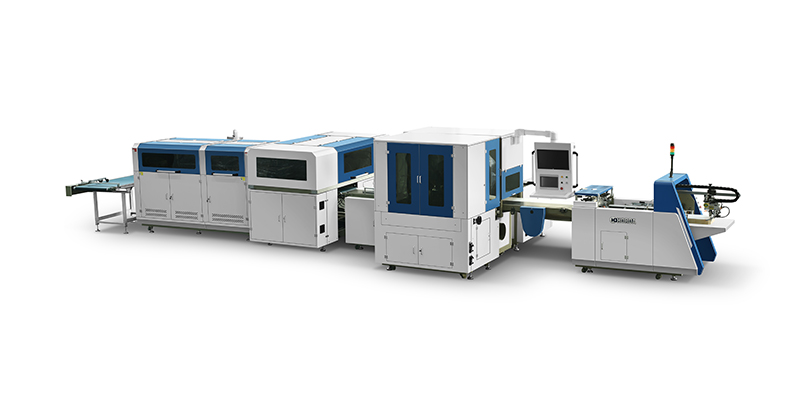
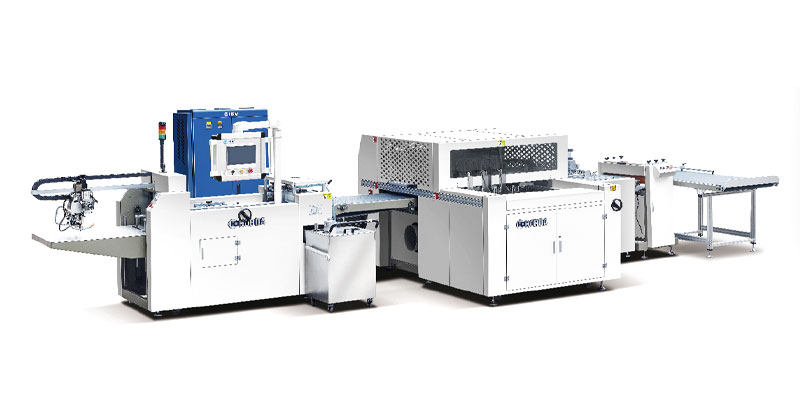
A fully automatic rigid box machine connects more operations into one controlled cycle. Materials or prepared components are fed into the machine, and processing continues with limited direct handling during normal production.
Within a case-making process, automatic operations may include cover feeding, gluing, board feeding, board positioning, corner folding, four-side edge turning and pressing. A connected line may also transfer the completed case directly into an inner lining process.
Fully automatic does not mean that the machine starts with raw greyboard and finishes every type of rigid box. Printing, surface finishing, board cutting, die-cutting, grooving, tray forming, insert installation and final assembly may still be separate processes.
It also does not mean operator-free production. Operators remain responsible for material preparation, setup, replenishment, inspection, cleaning, maintenance and abnormal condition handling.
Which Rigid Box-Making Processes Can Be Automated?
Rigid box automation can be divided into three production sections.
- Upstream material preparation: Greyboard slitting, die-cutting, grooving, paper printing and surface finishing prepare the materials. These processes are often completed by separate equipment.
- Main converting process: Paper feeding, gluing, board or shell positioning, corner pasting, forming, wrapping, edge folding and pressing create a flat case or three-dimensional box component.
- Downstream finishing and assembly: Inner lining, magnet insertion, tray attachment, wing assembly, lid-and-base matching, inspection and packing complete the required product.
One automatic machine may cover several operations within one section, while an integrated line may connect processes from two or more sections. The equipment scope should be described by its input, automatic actions and output rather than by the word “automatic” alone.
For a process-level explanation, see How Does a Rigid Box Machine Work?
How Much Manual Work Is Still Required?
In semi-automatic production, operators usually interact with individual products throughout the process. Manual work may determine how quickly materials are positioned, transferred and collected.
Fully automatic production reduces these repeated movements, but manual work shifts to the beginning, end and control points of the process:
- Preparing and staging board, paper and semi-finished components
- Loading material stacks and replenishing them during production
- Selecting settings and completing format changeovers
- Approving the first product before continuous production
- Monitoring feeding, adhesive and positioning conditions
- Clearing interrupted materials after a stop
- Installing special inserts and accessories
- Completing final inspection and packing
Labor requirements should therefore be calculated across the complete production route. Counting only the operators beside the main machine can overlook material preparation, intermediate transfer, assembly and downstream work.
Are Fully Automatic Rigid Box Machines Faster and More Accurate?
Fully automatic machines generally provide a higher and more stable production rhythm when materials are consistent and the order is long enough for continuous operation. Automatic feeding and positioning can also improve repeatability in board spacing, paper alignment, wrapped borders and folded edges.
However, maximum cycle speed is not the same as accepted output. Actual production is also affected by:
- Box dimensions and structure
- Material feeding behavior
- Batch length and changeover frequency
- Material replenishment and operator response
- Inspection, rejection and rework
- Machine stoppages and downstream capacity
A semi-automatic machine may have a lower mechanical speed but still achieve competitive net output on short or complicated orders because it can begin production with fewer connected adjustments.
Automation improves the repeatability of the movements it controls. It cannot completely correct inaccurate greyboard, distorted shells, curled paper, unsuitable adhesive or incorrect upstream processing.
Which Is More Flexible for Changeovers and Short Runs?
Semi-automatic production is often easier to reorganize for boxes that use different structures, materials or assembly methods. Individual machines can operate as separate production cells, allowing each order to pass through only the processes it requires.
Modern fully automatic machines may use servo adjustment, stored settings and replaceable format parts to shorten regular changeovers. This can make repeat orders with previously verified materials and settings efficient to restart.
However, a connected line may require several stations to be adjusted and synchronized. A useful changeover calculation should include:
- Removal of the previous materials
- Mechanical and software adjustments
- Replacement of molds, guides or format parts
- First-piece production and approval
- Startup waste before stable operation
- Cleaning when adhesives or materials change
For short orders, total order completion time is more meaningful than running speed after the machine has reached stable production.
What Materials Are Required for Automatic Rigid Box Production?
Automatic feeding and positioning require more consistent inputs because the machine repeats a defined sequence and cannot manually correct every individual sheet or shell.
- Cover paper: Controlled curl, stable dimensions, suitable grain direction and reliable sheet separation
- Greyboard: Consistent thickness, accurate cutting, clean edges and limited warping
- Board arrangement: Correct dimensions, sequence and gaps between separate panels
- Pre-formed shells: Square corners, stable walls and consistent dimensions
- Adhesive: Suitable viscosity, temperature, coating amount and open time
- Surface finishes: Sufficient resistance to feeding, positioning, folding and pressing
- Accessories: Consistent dimensions when magnets, plates, ribbons or other parts are automatically handled
A material that works during slow manual production may become unstable during continuous automatic feeding. Semi-automatic production allows an experienced operator to compensate for more variation, although controlled materials are still necessary for consistent quality.
How Does Automation Change Rigid Box Production Planning?
Semi-automatic production is usually organized around independent workstations. Semi-finished components can wait between operations, and work can be redirected when one station is occupied or unavailable. This creates flexibility but increases handling, work-in-progress and dependence on operator coordination.
A connected automatic line reduces intermediate handling and creates a more continuous material flow. In return, upstream preparation and downstream finishing must keep pace with the automatic section.
Automatic production therefore requires stronger control of:
- Order scheduling and material staging
- Capacity balance between connected stations
- Preventive maintenance
- Changeover procedures
- Quality inspection points
- Recovery after abnormal stops
Automation changes the way the factory is organized. It does not simply replace individual workers with a faster machine.
When Does More Automation Not Increase Output?
Adding automation to one process does not automatically increase the number of finished boxes leaving the factory. Total output remains limited by the slowest or least stable part of the production route.
More automation may fail to increase output when:
- Printing, cutting, die-cutting or grooving cannot supply materials fast enough
- Downstream lining, assembly, inspection or packing remains slower
- Connected stations have poorly matched capacities
- Orders change before the line reaches stable running conditions
- Materials cause repeated feeding, gluing or positioning interruptions
- Special inserts and accessories still require extensive manual assembly
- Setup, maintenance or fault recovery takes longer than expected
- Order volume is insufficient to keep the line effectively utilized
In these situations, automation may move the bottleneck instead of removing it. Effective output improves only when material preparation, machine capacity, labor arrangement and downstream operations are balanced.
Is a Fully Automatic Rigid Box Machine Always Better?
No. A fully automatic rigid box machine is not automatically better for every production method. It provides clear advantages when standardized materials, repeat structures and sufficiently long orders allow continuous operation.
Semi-automatic equipment retains value when a factory handles varied box structures, specialty materials, short batches or products with substantial custom assembly.
The meaningful comparison is not simply automatic versus semi-automatic. It is whether the production method delivers stable, saleable output with acceptable manual handling, changeover loss, material requirements and workflow complexity.