
How Does a Rigid Box Machine Work?
A rigid box machine automates one or more steps used to turn greyboard, cover material or prepared box components into a rigid box part or finished box. Depending on the machine, it may feed and glue cover paper, position board, form a box shell, paste corners, wrap the shell, fold edges, press surfaces or apply an inner lining. The exact working process can only be understood after confirming what enters the machine and what comes out.
The name “rigid box machine” does not describe one universal machine. A case-making machine that produces flat book-style covers works differently from a machine that forms and wraps three-dimensional lid-and-base box shells. Some machines complete one process, while integrated lines connect several processes.
What Does a Rigid Box Machine Do?
A rigid box machine replaces selected manual operations with controlled feeding, gluing, positioning, forming, folding or pressing. Automation improves the repeatability of these operations, but it does not mean that every machine starts with raw greyboard and finishes with a complete box.
Depending on its design, a rigid box machine may be responsible for one or more of the following production stages:
- Preparing greyboard by cutting or grooving it.
- Forming a flat board blank into a three-dimensional box shell.
- Fixing the shell corners with tape or adhesive.
- Applying adhesive to printed or decorative cover paper.
- Positioning greyboard pieces or a box shell on glued paper.
- Wrapping paper around a shell or folding it around a flat case.
- Pressing the wrapped component to improve adhesion and flatness.
- Applying inner paper to a completed flat case.
- Joining prepared cases, trays, sleeves, necks or side wings.
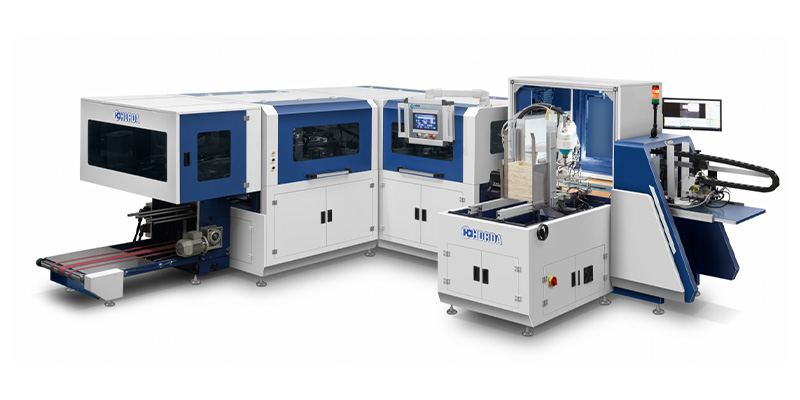
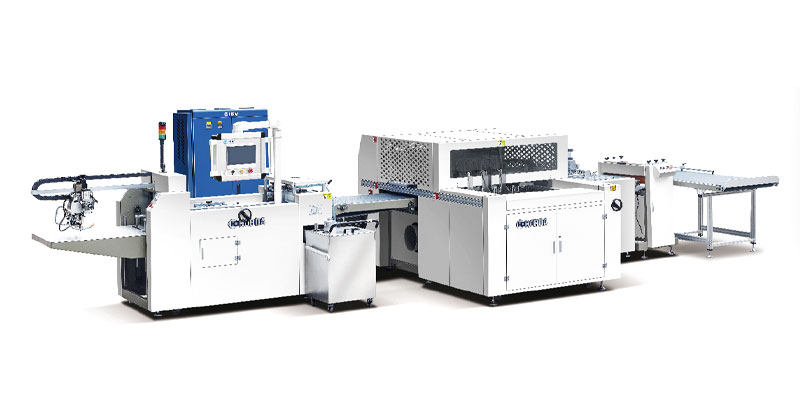
For example, a high-speed automatic rigid box case machine can combine cover feeding, gluing, board positioning and four-side folding. Its output is a flat case used for book-style boxes, magnetic box covers, folders and other hardcover products. It does not use the same workflow as a machine that forms a lid or base into a three-dimensional shell.
The main purpose of automation is therefore not simply to “make a box.” It is to control specific production movements so that material placement, adhesive application, folding and pressing can be repeated consistently throughout a production batch.
What Goes Into a Rigid Box Machine?
The input depends on the process performed by the machine. Some machines receive flexible sheets and separate board pieces, while others receive a grooved blank, a pre-formed box shell or several prepared components.
Cover Paper
Cover paper may be printed paper, specialty paper, coated paper, textured paper, cloth or another decorative covering material. It normally needs to be cut to the required size before entering the wrapping or case-making process.
Paper curl, surface coating, stiffness, grain direction and dimensional variation can affect feeding, gluing, positioning and folding. A material that runs successfully at a low speed may still become unstable during continuous production.
Greyboard Pieces
A flat case may use separate front, back, spine and side boards. These pieces must be cut to the correct dimensions and supplied in the correct order.
The gaps between board pieces are also important. In a book-style case, the spacing beside the spine affects how the finished cover opens and closes. Incorrect spacing may cause resistance, surface creasing or poor alignment when the inner tray is attached.
Grooved Board Blanks
Some forming processes use a single greyboard blank with V-shaped grooves. The grooves create controlled fold lines that allow the board to form sharp corners.
Groove depth, width and position must match the board thickness and box dimensions. A groove that is too shallow may resist folding, while an excessively deep groove can weaken the board or damage the outer surface.
Pre-Formed Box Shells
A wrapping machine may receive a three-dimensional lid, base or tray that has already been formed and corner-pasted. The shell should be square, stable and dimensionally consistent before it reaches the wrapping process.
A distorted shell cannot normally be corrected completely by wrapping or pressing. It may produce uneven walls, poor corners or an incorrect lid-to-base fit.
Inner Lining Paper
Book-style cases and other hardcover products may require inner paper to cover the exposed board, folded cover edges and hinge area. The lining paper must be cut to the correct size and positioned accurately inside the flat case.
Incorrect lining size or position can create exposed edges, bubbles, wrinkles or resistance when the case is folded.
Adhesive
The adhesive must be compatible with the cover material, greyboard and application system. Viscosity, temperature, open time and coating amount affect bonding, flatness and production stability.
Too much adhesive may increase drying time or contribute to warping. Too little may cause loose edges, bubbles or delamination. The correct operating range depends on the adhesive, materials, machine and factory conditions.
Main Rigid Box Machine Working Steps
There is no single working sequence for every rigid box machine. The following are two common production paths.
Flat Case-Making Process
This process is commonly used for book-style rigid boxes, magnetic box covers, hardcover cases, folders and similar products.
- Cover feeding: A feeder separates and delivers the prepared cover sheet into the machine.
- Adhesive application: The sheet passes through a gluing unit that applies a controlled adhesive layer.
- Board feeding: Front board, back board, spine board or other board pieces are supplied in the required sequence.
- Board positioning: Mechanical guides, photoelectric detection or a vision system aligns the boards with the cover paper.
- Edge folding: The machine turns the cover paper over the board edges and completes the required folding sequence.
- Pressing and delivery: The flat case is pressed or conveyed out for inspection, inner lining or later box assembly.
The output remains flat. It becomes part of a complete rigid box only after the tray, magnets, neck, side wings or other components are added.
Three-Dimensional Shell Forming and Wrapping
Lid-and-base boxes, trays and other three-dimensional rigid box parts follow a different route.
- Board preparation: Greyboard is cut, grooved or divided into the required blank or panel arrangement.
- Shell forming: The board is folded into a three-dimensional shape.
- Corner fixing: Corners are held with tape, adhesive or another fixing method.
- Cover gluing: Adhesive is applied to the prepared wrapping paper.
- Shell positioning: The formed shell is placed accurately on the glued cover paper.
- Side wrapping: The paper is lifted and wrapped around the outer walls of the shell.
- Edge turning: Remaining paper is folded over the top edges and into the interior.
- Pressing: The wrapped component is pressed to improve contact, surface smoothness and dimensional stability.
A lid and a base are normally produced as separate components. Their dimensions must be coordinated so that the finished lid fits the base with the required opening resistance.
Connected and Integrated Processes
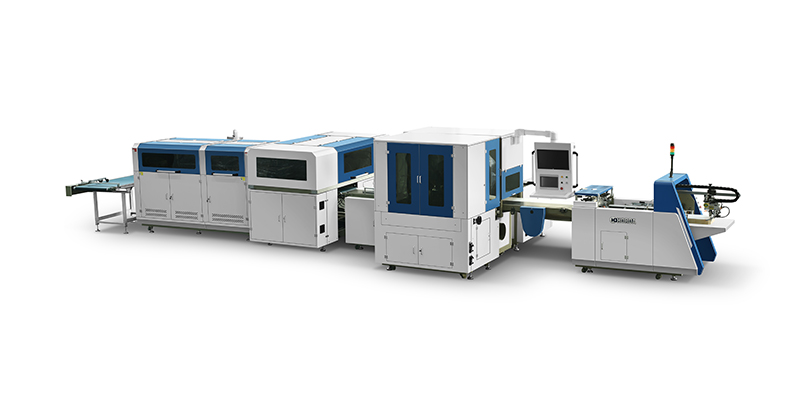
Some equipment connects two or more processes. A flat case may move directly from case making to inner lining, or a formed shell may transfer automatically from positioning to wrapping and pressing.
Integration reduces manual transfer, but each connected section still performs a defined job. The complete line must maintain compatible speed, product direction and positioning references between the individual processes.
Key Parts of a Rigid Box Machine
Machine construction varies, but most automatic systems contain several functional groups.
Paper Feeder
The paper feeder separates and delivers cover sheets one at a time. Stable feeding prevents double sheets, missing sheets and skewed paper.
Feeding performance depends on paper flatness, surface friction, static electricity, pile condition and machine settings. Increasing suction is not a universal solution because excessive force may also damage or deform some materials.
Gluing Unit
The gluing unit applies adhesive to the cover paper or another component. A stable coating should cover the required area without excessive accumulation, dry spots or contamination.
Uneven gluing may lead to bubbles, loose edges, staining, paper sticking or box warping.
Board or Shell Feeding System
This system delivers separate greyboard pieces, a grooved blank or a pre-formed shell. The components must arrive at the correct position and time in relation to the glued paper.
Incorrect delivery can change board spacing, interrupt the production rhythm or place the wrong component on the cover sheet.
Positioning System
The positioning system aligns greyboard or a shell with the cover material. Depending on the machine, it may use mechanical guides, photoelectric sensors, cameras, servo correction or robotic handling.
Positioning accuracy affects printed-design alignment, border width, spine position and the final appearance of the product. However, machine positioning cannot compensate for every cutting or material error.
Folding or Wrapping System
A folding system turns cover paper around flat boards, while a wrapping system lifts and folds paper around a three-dimensional shell. The movement sequence must suit the board arrangement, paper properties and corner structure.
Incorrect folding may create wrinkles, exposed board, loose edges, damaged corners or uneven turn-ins.
Pressing System
Pressing improves contact between the cover material and the board. It can help remove trapped air and produce a flatter surface.
Pressure must be controlled because insufficient pressure may leave bubbles or loose areas, while excessive or uneven pressure may mark the paper or deform the component.
Conveyors and Transfer Units
Conveyors move materials and semi-finished products between processes. In an integrated line, transfer units may also rotate, turn or reposition a case before the next operation.
Unstable transfer can change product position, damage the surface or create a production bottleneck.
PLC, HMI and Motion Control
The control system coordinates feeding, positioning, folding, pressing and machine alarms. Operators use the HMI to enter product settings, monitor operation and identify faults.
A servo motor, camera or imported electrical component does not determine finished-box quality by itself. Accuracy also depends on mechanical rigidity, calibration, material consistency, adhesive behavior and correct machine settings.
What Comes Out of the Machine?
The output may be a prepared material, a semi-finished component or a more complete box. This distinction is essential when comparing machines.
Grooved Board Blank
A grooved board blank is still flat. It has controlled fold lines but has not yet been formed, corner-pasted or wrapped.
Corner-Pasted Shell
A corner-pasted shell is a three-dimensional lid, base or tray. It has the basic box shape but still requires wrapping, edge turning and pressing.
Wrapped Box Component
This may be a completed lid, base or tray covered with decorative paper. It may still require lining, fitting, assembly or the addition of inserts and accessories.
Flat Case
A flat case is a wrapped board structure used for a book-style box, magnetic box, folder, calendar cover or hardcover product. It normally requires later assembly with a tray or other box component.
Lined Case
A lined case has inner paper applied to cover the board and folded cover edges. It may be ready for tray attachment, magnet-related assembly or another downstream process.
Assembled Rigid Box
Some assembly equipment joins prepared cases, trays, sleeves, necks or wings. Whether this output is a complete finished box depends on the remaining inserts, closures, accessories and quality checks.
The word “automatic” only describes how the stated process is performed. It does not prove that the output is a finished retail-ready box.
Is One Machine a Complete Production Line?
Usually, one machine is not a complete rigid box production line. A full manufacturing workflow may include printing and surface finishing, paper die-cutting, greyboard cutting, grooving, shell forming, corner pasting, gluing, positioning, wrapping, lining, assembly and final inspection.
However, not every box requires every process. A book-style magnetic box uses a flat case and an inner tray, while a standard lid-and-base box requires two separately formed and wrapped shells. Their production lines therefore need different machines and transfer arrangements.
Some equipment connects related processes. For example, an integrated rigid box case making and lining production line can produce a flat case and apply its inner paper in one connected workflow. Its defined line scope is case making plus inner lining. Tray production, magnet placement and final box assembly depend on the product structure and project configuration.
To understand whether a machine or line is complete, confirm four points:
- What materials or components enter the first station?
- Which processes are completed automatically?
- What physical product leaves the final station?
- Which upstream and downstream processes are still required?
A line should be evaluated by these process boundaries rather than by names such as “all-in-one,” “fully automatic” or “complete rigid box line.”
Which Box Types Use Different Processes?
The box structure determines the required manufacturing route. Terms such as luxury box, gift box, cosmetic box or jewelry box describe an application, but they do not define how the box must be made.
Lid-and-Base Boxes
A lid-and-base box has two separate three-dimensional shells. The lid and base are formed and wrapped separately before their fit is checked.
The process must control shell dimensions, wall shape, cover-paper position and the clearance between the two parts.
Drawer Boxes
A drawer box combines an inner tray with an outer sleeve. The tray and sleeve normally follow different production processes.
The critical requirement is controlled sliding clearance. If the fit is too tight, the drawer may become difficult to open. If it is too loose, the package may feel unstable.
Book-Style Boxes
A book-style box uses a flat case as its outer cover. An inner tray is attached to the case after case making and, when required, inner lining.
Board spacing beside the spine affects opening movement, while tray position affects the alignment of the closed box.
Magnetic Rigid Boxes
Many magnetic rigid boxes use a book-style structure. Magnets or metal plates are installed in selected areas before they are covered by lining paper or other materials.
Case production, magnet placement, lining and tray assembly may be completed by separate machines or workstations.
Shoulder and Neck Boxes
A shoulder or neck box uses a lid, base and raised inner neck. The neck is produced separately and assembled inside the base.
Its height, position and fit affect the appearance of the shoulder and the way the lid closes.
Collapsible Rigid Boxes
A collapsible rigid box uses rigid board panels connected by flexible joints, wings, tape, magnets or other closure parts. It remains flat during storage and transport but forms a stable box when erected.
Board spacing and joint movement are critical. A small position error can prevent the box from folding flat or opening squarely.
Round Rigid Boxes
A round rigid box uses a cylindrical wall rather than a flat case or rectangular shell. Tube forming, circular wrapping and lid fitting require different machinery and process controls.
A machine designed for standard rectangular cases should not be assumed to produce round boxes simply because their dimensions fall within its stated size range.
Frequently Asked Questions
Does a Rigid Box Machine Cut the Greyboard?
Some production lines include board cutting or grooving equipment, but many rigid box machines require greyboard that has already been cut into the correct pieces. The machine specification should state whether board preparation is included.
Can One Rigid Box Machine Make Every Box Style?
No. Lid-and-base, drawer, book-style, shoulder, collapsible and round boxes use different components and manufacturing sequences. A machine may support several products within a defined process, but it is unlikely to complete every structure without additional equipment or modules.
Does Fully Automatic Mean No Operator Is Needed?
No. Operators may still load materials, select recipes, complete changeovers, inspect the first piece, monitor adhesive, remove finished products and perform cleaning or maintenance. Automation reduces repeated manual handling but does not eliminate production management.
How Does a Rigid Box Machine Keep Materials Aligned?
Depending on the machine, alignment may use mechanical guides, photoelectric sensors, cameras, servo correction or robotic handling. The positioning method must suit the print design, material surface and required accuracy.
Is Case Making the Same as Box Forming?
Not necessarily. Case making usually produces a flat wrapped cover made from several board pieces, while box forming generally creates or finishes a three-dimensional shell. Supplier terminology varies, so the input and output should always be confirmed.
What Determines Actual Machine Output?
Actual output depends on effective running speed, box size, material behavior, batch length, changeovers, material replenishment, inspection, downtime and first-pass yield. Maximum cycle speed alone does not represent the number of saleable boxes produced during a normal shift.
Final Takeaway
A rigid box machine works by controlling one or more material-feeding, gluing, positioning, forming, wrapping, folding, pressing, lining or assembly processes. The exact sequence depends on the machine and the box structure.
The clearest way to understand any rigid box machine is to identify its input, automatic processes and output. A flat case, a formed shell, a wrapped lid and a completed rigid box are different products, even when the equipment used to make them is described by the same general machine name.